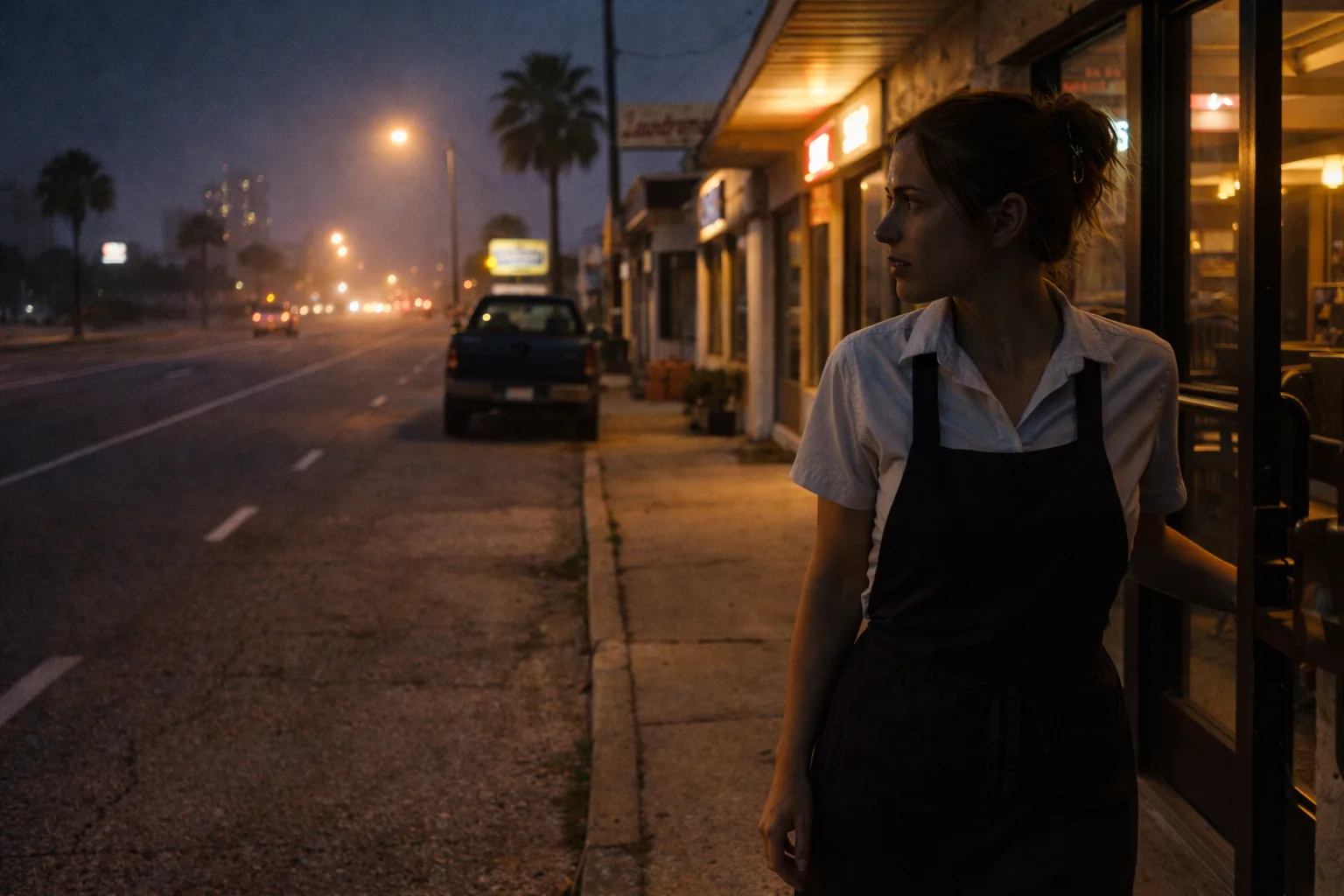
The sun is doing that thing it does in Panama City Beach around 7:30 in the evening -- turning the sky into something that makes people reach for their phones. The Gulf of Mexico goes copper and pink and the sand holds the last warmth of the day and somewhere along the strip, a woman in a black apron is carrying two margaritas to a table of four who will not remember her face by morning.
Her name does not matter for the purposes of this story. It could be any of them. She is composites. She is the person you see every day on vacation and never think about once you leave.
Two Versions of the Same City
There is the PCB that exists on Instagram. White sand, emerald water, pontoon boats, seafood platters at sunset, kids with ice cream, couples walking barefoot along the shore while the sky turns impossible colors. It is beautiful. It is real. It is one of the most photogenic stretches of coastline in the American South and the tourism machine that sustains it is massive and well-oiled.
Then there is the other PCB. The one that starts at 4:45am when an alarm goes off in a motel room three miles from the beach. The room costs by the week. The parking lot is cracked. The ice machine has not worked since February. The woman who will serve your drinks tonight is already up, making coffee in a pot that plugs into the wall because the room does not have a kitchen.
She has two jobs. The morning one starts at six. She cleans rooms at a mid-range resort -- the kind with a pool and a lazy river that families from Alabama and Georgia book months in advance. She makes the beds look like nobody ever slept in them. She folds the towels into shapes. She replaces the tiny shampoo bottles and wipes down surfaces that were wiped down yesterday and the day before that. By noon, her back hurts in a way that has become so constant she has stopped noticing it.
The Afternoon Gap
Between two and four, there is a gap. Not enough time to go home and rest properly, too much time to sit in a car. She drives to a Walmart parking lot, reclines the seat, and sets an alarm on her phone. Sometimes she sleeps. Sometimes she scrolls through messages from her sister in another state. Sometimes she just stares at the ceiling of her car and exists in the specific kind of tiredness that is not sleepiness but something deeper -- a tiredness of repetition, of knowing that tomorrow will look exactly like today.
At four-thirty she changes in the restaurant bathroom. Black pants, black apron, hair up. Smile on. The evening shift runs until close, which could be ten or could be midnight depending on the crowd. In season, it is almost always midnight.
The Money Math
Here is where people who have never worked service get confused. They see a busy restaurant and assume the servers are making good money. And on a Saturday night in July, yes -- a strong server can walk with decent tips. But averages are not peaks. The Tuesday lunch shift in October pays almost nothing. The slow weeks between Thanksgiving and Spring Break are brutal. And the hourly wage before tips in Florida is still below what most people would consider a living wage.
She does the math constantly. Rent. Car insurance. The phone bill. Gas, which is not nothing when you are driving between two jobs five days a week. Food -- actual groceries, not the restaurant food she is around all day but cannot afford to eat. Health insurance, which she does not have because neither job offers it and the marketplace plans cost more than her car payment.
The math works. Barely. It works the way a rope bridge works -- you can cross it, but you would not call it stable, and one unexpected expense could snap the whole thing.
She is not struggling because she is not working hard enough. She is struggling because the structure she works within was not designed with her stability in mind.
What the Tourists Don't See
The tourists do not see the bus stop at midnight. They are in their condos by then, sunburned and full, scrolling through the photos they took at sunset. They do not see the woman waiting under a streetlight for a ride that may or may not come, because her car is in the shop and the repair costs more than she has in checking.
They do not see the conversation she has with her manager about needing a specific day off for a doctor's appointment -- a conversation that should be straightforward but is not, because in seasonal work, asking for a day off is asking for a cut in hours, and a cut in hours is a cut in tips, and a cut in tips is the difference between making rent and not.
They do not see her at the laundromat at 11pm on a Wednesday, folding uniforms for both jobs, watching a sitcom on her phone with one earbud in. They do not see the efficiency with which she has learned to live -- every hour accounted for, every dollar assigned before it arrives, every meal planned around what is cheapest and what will last.
She is not a character in a story about poverty. She is a person with competence, with intelligence, with the kind of organizational skill that in another context would earn her a management title and a salary. She is not broken. She is contained. Held inside a system that values her labor at exactly the amount it can get away with.
The Fog at Five AM
There is a moment, most mornings, when the fog rolls in off the Gulf and the whole beach looks like a dream someone is waking up from. The sand is empty. The water is gray-green and slow. The high-rises are silhouettes. It is the most beautiful version of this city and almost no tourist ever sees it because they are still asleep.
She sees it. Every morning, driving to work, she passes the beach and the fog is there and the city is quiet and for thirty seconds, maybe a minute, she is the only person who knows what this place looks like when it is not performing.
That version of PCB -- the real one, the one before the music starts and the umbrellas go up and the Instagram posts begin -- belongs to the workers. They are the first ones here every morning and the last ones to leave every night. They maintain the fantasy that others come to experience. And when the season ends and the tourists go home, they are still here, still working, still driving to the Walmart parking lot between shifts.
What This Has to Do with Recruitment
Everything.
We are a recruitment agency. We place people in jobs. That is the mechanical description of what we do. But if we are being honest -- and this piece is about being honest -- what we actually do is decide whether a placement improves someone's life or merely fills a shift.
Those are not the same thing. Filling a shift is easy. There is always someone who needs the work badly enough to take whatever is offered. But a placement that improves a life -- one that offers stability, reasonable hours, a livable wage, a path to something better -- that requires intention. It requires the recruiter to care about where the person goes, not just that the position gets filled.
We know the woman at the bus stop. Not her specifically, but her situation. We have placed people like her, and we have seen what happens when a placement is done right versus when it is done fast. The difference is not abstract. It is the difference between a motel room and an apartment. Between two jobs and one. Between surviving and starting to build something.
Everyone deserves a placement that improves their life. Not just fills a shift.
That is not a tagline. It is the only thing that makes this work mean anything.